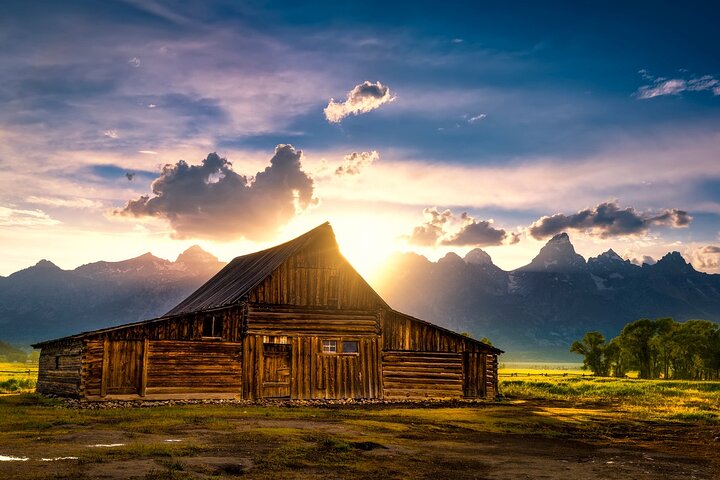
The sun edges low behind a serrated skyline and the Tetons, like a row of patient sentinels, drink the light. You sit in leather-upholstered comfort as the vehicle slips through sagebrush-scented air, and your guide—voice tuned to equal parts naturalist and photo editor—points out a silhouette in the willows: a bull moose, neck thick with muscle, daring you to get closer. For the next four hours this private, luxury half-day tour hands you the best of Grand Teton National Park on a careful scale: wildlife viewings, sweeping photographic stops and a primer on the geology and culture that carved this place.
Grand Teton’s drama comes down to edges. The jagged peaks rise roughly 7,000 vertical feet above the valley floor, a youthful mountain range in the Rockies where uplift along the Teton fault and late‑Ice Age glaciers did most of the heavy sculpting. That lack of deep erosion leaves knife‑sharp ridgelines and bowl‑shaped cirques—scenery that translates beautifully through a camera lens and even better through a private itinerary that can pivot to where the light, and the animals, are working best.
This tour is not a group shuffle through predefined overlooks. It’s a curated loop through a living museum: wetlands where elk and moose bed down and bald eagles watch the river like a gambling dealer; juniper and aspen rims that flare copper in September; quiet pullouts for long lenses and longer silences. Guides tailor stops to your interests—wildlife-focus, geology lessons, or photography coaching—so you get the subject matter, the context and the composition in one sweep. That flexibility is the luxury: you aren’t following a clock so much as following the moment.
History here reads in two scripts: indigenous presence that predates mapping and the Euro‑American story of trappers, homesteaders and later, conservationists who helped shape the park. The valley’s flatlands were once the seasonal highways for Shoshone peoples; later, the Snake River became both resource and route for settlers. Today, the park is a patchwork of scientific research, regulated tourism and thoughtful stewardship—conditions that make a private tour valuable because it comes with a steward who can interpret the landscape rather than just show it.
Logistically, this is a half‑day mining of high‑value experiences. You’ll typically depart from Jackson or a nearby staging area, traverse lowland riparian corridors and climb to viewpoints that catch the best light for photography. Wildlife sightings are common but never guaranteed—animals have their own timetables—but a seasoned guide knows where to listen and wait. Expect multiple short stops for binocular checks, scenic breakfasts of air and light, and at least one place where the guide will share a concise, usable explanation of the Tetons’ uplift and glacial history that makes the scenery feel less like decoration and more like context.
For the practical traveler: book mornings for wildlife and softer light, or late afternoons if you want dramatic sunset color on the peaks. Private tours in this scale come at a premium—this experience is positioned as a luxury option and the price reflects that—but if your goal is quality encounters, fewer people and an expert who can make the landscape read on multiple levels, it’s worth it.
What to expect on the ground: comfortable, climate‑controlled transport; a guide with optics and local knowledge; frequent photo stops; and an adaptable route that prioritizes wildlife safety and scenic timing. What not to expect: long hikes or technical mountaineering—this is about place, perspective and presence rather than sweat equity. The park rewards patience: the slower you move, the more the place reveals (and the more likely you are to watch a bison herd graze into the golden hour).
If you care about minimizing your footprint, ask the operator about group size limits, leave-no-trace practices and how they manage wildlife encounters. For those who want to extend the impression the Tetons leave on you, plan an afternoon in Jackson—dinner at a local spot, a beer at a craft brewery, or a walk through the Town Square where elk frequently wander close enough to change your idea of “urban wildlife.”
In short: this is a high-value, low-hurry way into the core of Grand Teton National Park. It’s best for people who want close encounters with the landscape and animals without committing to a full-day trek or multi-day backcountry plan. With an expert guide, good timing and an appetite for sharp mountain light, those four hours can feel like a concentrated education in how landscapes are made and how wildlife lives inside them—luxury that yields understanding as well as photographs.