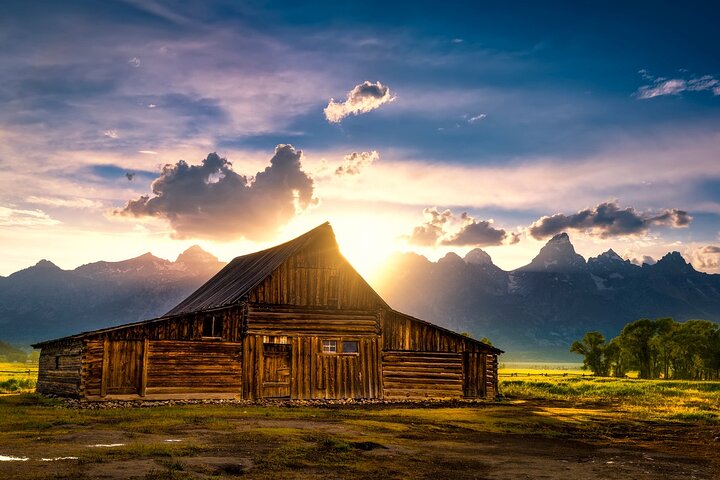
The sun slips behind the jagged teeth of the Teton Range and for a brief, brilliant minute the sky turns a molten copper. Your chauffeur eases the vehicle onto a gravel pullout; a hush falls that feels engineered by the mountains themselves. Out here, away from the neon of Jackson Hole, the air has the clarity of cold steel and the scent of sagebrush and pine. Servers lay a linen on an improvised table and set out a sundowner cocktail—the citrus cut through with a whisper of local bitters—while the first stars begin to puncture the twilight.
This is the private sundowner dinner experience in Grand Teton National Park: a three-to-four-hour, chauffeur-driven excursion that trades the choreography of restaurants for a carefully staged, safari-style meal in the field. It’s not camping; it’s a deliberate, high-touch encounter with place. You are seated into the landscape as surely as any tableau on a gallery wall: mountains for backdrop, sky for ceiling, a quiet valley for an audience.
The Tetons themselves read like an open geology book. Unlike older, softened ranges, the Tetons are a young, steep-faced uplift that began rising roughly nine million years ago along the Teton fault—an energetic, vertical motion that left the range stark and dramatic. Human history here is layered: Shoshone bands hunted these valleys for millennia; Euro-American trappers sketched the first crude maps in the early 19th century; conservationists pushed for park protections that culminated in the establishment of Grand Teton National Park in 1929. The dinner service nods to these threads—local ingredients, a narration that gives context to the valley’s formation, and a respect for the dark sky and wildlife rhythms.
There’s practical theater to the experience. The drivers are local, schooled in both safe winter driving and in the social etiquette of wilderness dining: where to park for light, how to keep food secure from curious wildlife, and when to call the whole party back to the vehicle if a bull elk wanders through. The culinary part is deliberately low-fuss: a cocktail, a multi-course meal plated and presented in the field, and a gradual return under night-sky splendor. For many travelers, the appeal is simplicity—an evening crafted around sunset and conversation, not a schedule of tastings or tours.
Why do this instead of dinner in town? First, the skyline. The Tetons are a sculpture that changes its mind as the light shifts; an in-town meal doesn’t compete with that. Second, the intimacy. This is a private tour designed for celebrations and small groups—birthdays, proposals, family reunions—where the goal is memory over menu. Third, the access: a short drive from Jackson but feeling a world away. For wildlife lovers, there’s an edge of possibility—moose browsing in willows, elk bugling if you're early in the season, and if you’re lucky, a red fox slipping along the treeline.
Planning notes that will improve the evening: the outing lasts three to four hours, so think in layers. Even midsummer evenings in the Tetons cool quickly after sunset. Park entrance fees generally apply, and while this is a private tour, the operator’s vehicle must comply with park rules; confirm whether entrance fees or permits are included. Given the private nature and personalized service, prices start at a premium—expect from USD 720 for the experience—and that can be well worth it if you value privacy and a turnkey evening.
Safety and etiquette matter. Grand Teton is bear country; do not leave food unattended and follow the guides’ instructions about where to set up. The providers running these dinners are practiced in Leave No Trace principles—trash is packed out, light is minimized to avoid disturbing wildlife, and campfire use (if any) follows park regulations. If you have dietary restrictions, communicate them in advance: the experience is designed to be tailored, but kitchen logistics in the field take time.
Timing is everything. Aim for late-summer or early fall for the most reliable weather and the richest window of evenings—September’s clear nights can make the Milky Way leap above the range. If you’re there in spring, the valley still carries spring runoff and lingering chill; winter dinners are possible but will depend on road conditions and often require special arrangements.
Practical tips for the evening: bring a warm midlayer and a wind shell, close-toed shoes for gravel and short walks, and binoculars if you want to watch distant ridgelines for movement. Keep your camera ready—the light lasts only a short time, and the color transitions are swift. Most of all, be present: the point is not just the food but the way the landscape reclaims you into its scale for an hour or two.
This dinner is not merely about taste; it’s a way to read the place. The conversation you’ll have with your driver about the fault that raised these peaks, or the ranger’s note that the valley’s willows are critical moose habitat, threads the meal to a larger ecosystem. When the server packs up and the lights go low, you’ll carry a sunset home that feels like one more feature of memory—crisp, slightly luminous, and undeniably Teton.
If you book, expect familiarity, not spectacle: a private, well-executed evening with local flavor, strong logistical smarts, and the kind of quiet that only a jagged skyline can deliver. For travelers who want their celebration wrapped in the scale of the American Rockies, this sundowner is a concise, elegant way to make the Tetons the centerpiece of the night.