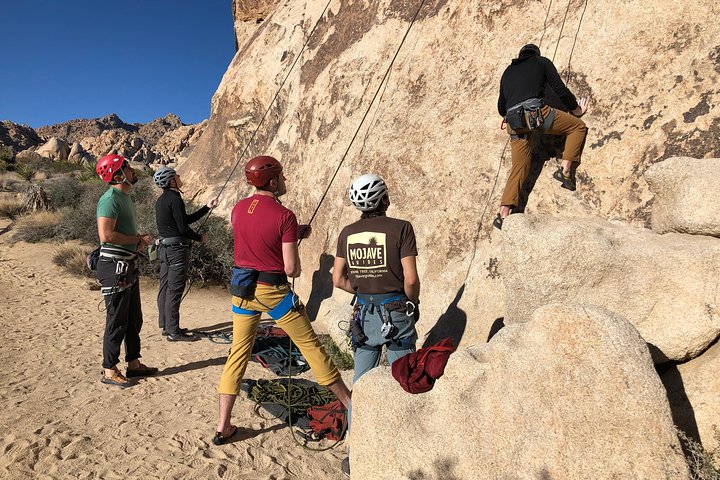
The morning wind smells like sand and sage, and it moves through the grooved trunks of Joshua trees as if shrugging awake. You haul a light pack out of a guide van somewhere between Palm Springs and the park gate, pull on sneakers that feel a half-size too small, and meet a small group of strangers who will, by noon, be partners on a rope. The granite faces of Joshua Tree do not demand flashy technique; they demand attention. They wait. They test. They reward.
Mojave Guides meets guests for this four-hour, beginner-friendly climb that introduces you to top-rope basics, belaying, and the tactile joy of granite under your palms. The routes average around 100 feet—enough height to make your pulse register the moment you push into vertical space, but short enough that fear gives way quickly to focus. The rock here is not alpine; it is desert granite with coarse, hand-holding texture and a million micro-features. Each plug and crack becomes a conversation between human and stone.
Joshua Tree is a place of angles. Geologically, the park sits where the Mojave and Colorado deserts overlap, but its soul is granitic. The rock you climb was born deep underground 100 million years ago, then uplifted and exposed as softer materials eroded away. The rounded monoliths and slabby faces are the result of exfoliation—sheets of rock peeling like the layers of an onion. Climbers prize this texture; it allows friction climbs and delicate footwork that reward patience over brute strength.
There is a history in the names too. Hidden Valley, Ryan Mountain, Intersection Rock—these are waypoints on a map that mixes settler tales, homesteaders, and a later generation of climbers who arrived in the 1950s and 60s. Climbers like John Bachar and Royal Robbins helped turn Joshua Tree into a proving ground for rock techniques that spread across the West. Today the park is equal parts outdoor laboratory and spiritual refuge, drawing photographers, stargazers, and artists as well as climbers.
Culturally the park sits in the traditional territory of several Native American tribes, including the Chemehuevi and Serrano. Their ancestral knowledge of the land is older than the cinder trails and picnic sites. Nowadays the desert is a fragile public space: its cryptobiotic soil, rare plants, and nocturnal wildlife respond quickly to use. Guides trained to lead climb programs carry more than ropes: they carry a code of low-impact travel and a practiced respect for the landscape.
This trip compresses a lot: safety fundamentals, the physics of ropes, and a quick course in risk management, plus the sincere thrill of topping out. Out on a face, the wind is a character all its own. It will try to steal your hat, test your balance, and sculpt the soundscape with a dry hiss. The Joshua trees stand like cartoony sentinels; their twisted arms point like index fingers at the horizon where the San Bernardino range sits as a serrated backdrop.
Why do this if you could walk less vertiginous trails? Because climbing in Joshua Tree offers an intimacy with the rock and a quick, accessible escalation of experience. Nothing accelerates a sense of presence like trusting a partner and then trusting the rope. For beginners, the route selection is conservative: slab work, friction moves, and easy cracks that teach foot placement and body positioning. The guide calibrates instruction to your comfort level—some guests spend the session learning to belay, others climbing multiple top-ropes, and many simply getting used to the vertical perspective.
Practical matters matter here. The tour is listed as a half day—about four hours—and runs year-round with best windows in spring and fall when heat is moderate. The group format keeps costs around the listed rate of about USD 240 per person, and equipment is provided: harness, helmet, and shoes in most cases, though bringing your own shoes can make the difference in comfort. Bring 1 to 2 liters of water, sun protection, and shoes with reasonably sticky soles if you plan to rent harnesses only. Cell service is intermittent inside the park, so plan pick-up and drop-off logistics with your operator beforehand.
There are a few tangible takeaways beyond the tick on your bucket list. You will learn to tie a figure-eight knot that will sit like a little lifebuoy in your hands; you will practice trusting a belayer who will function as a human shock absorber; and you will finish with a taste for how movement on rock feels—slow, deliberate, and oddly meditative.
If you leave with dust in your hair and a new team of climbing friends, that is part of the point. This program is designed as a doorway: a short, guided bridge between curious day hikers and climbers who want more technical instruction. The routes in Joshua Tree are infinitely repeatable in their variety—each face offers a new problem to solve. And for the practical-minded traveler, this half-day tour fits neatly into a larger desert itinerary: pair it with a sunrise at Keys View, a stroll among the boulder piles at Hidden Valley, or an evening meal back in Palm Springs where you can process the day under neon lights.
This is not an adrenaline thrill for adrenaline's sake. It is a calibrated exposure to vertical space, set in a landscape that is at once stark and generous. If you want to learn to climb or simply test your nerve on real rock, this guided experience in Joshua Tree is a compact, well-run introduction that leaves you higher than when you arrived—literally and in the set of your shoulders. The granite does not change, but you do. You will descend with sand in your shoes, sunburn on your neck, and that small, compelling ache that means you pushed a limit. That ache is a good sign: you are paying attention.


